Content Personalization vs. Dynamic Content: What Marketers Need to Know
In today’s marketing landscape, relevance is everything. Customers expect experiences tailored to their preferences, behavior, and context whether they’re browsing a website, checking email, or engaging on social media. Two terms often used in this context are content personalization and dynamic content. While related, they are not the same and knowing the difference can help marketers use the right approach at the right time.
What Is Content Personalization?
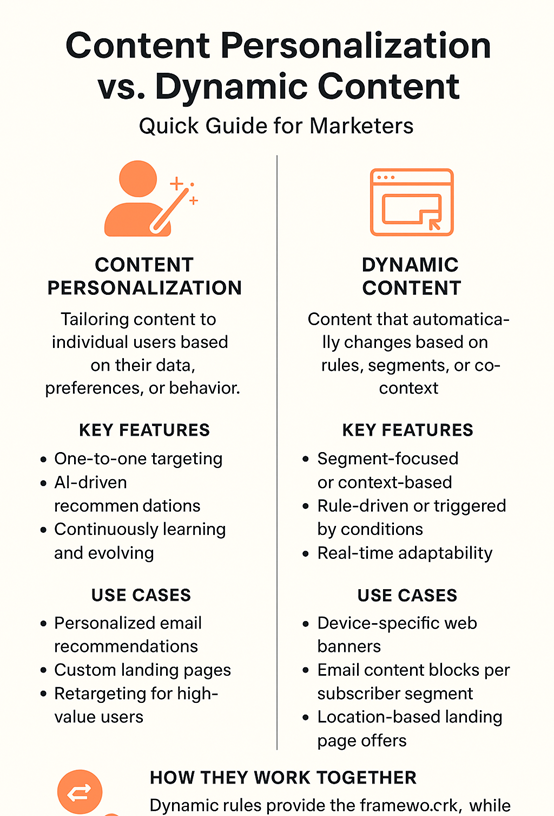
Content personalization is the practice of tailoring messages, offers, or content to individual users based on their preferences, behavior, demographics, or lifecycle stage.
Key characteristics:
- Individual-focused: Each user sees content that’s relevant to them.
- Data-driven: Uses customer data, AI, or analytics to inform messaging.
- Continuous learning: Recommendations adapt over time as user behavior changes.
Examples:
- Product recommendations on an e-commerce site based on previous purchases.
- Email messages that address a customer by name and include relevant offers.
- Personalized landing pages that reflect the visitor’s location or segment.
When to use:
- Building loyalty or driving repeat purchases.
- Engaging specific high-value audiences.
- Creating one-to-one experiences where relevance drives conversions.
What Is Dynamic Content?
Dynamic content refers to content that automatically changes based on rules, conditions, or context. Unlike personalization, it doesn’t necessarily require individual-level data it can adapt for groups, segments, or situations.
Key characteristics:
- Rule-based or contextual: Content changes depending on predefined triggers or conditions.
- Segment-focused: Can be tailored for segments rather than individual users.
- Immediate adaptation: Updates in real time based on user behavior, device, or location.
Examples:
- Website banners showing different promotions for desktop vs. mobile users.
- Email sections that swap content blocks depending on subscriber segment.
- Landing pages that adjust offers based on traffic source or geography.
When to use:
- Delivering relevant messaging to large audiences without individual-level data.
- Optimizing content for device, location, or campaign-specific conditions.
- Quickly testing and adapting campaigns in real time.
Key Differences Between Personalization and Dynamic Content
| Aspect | Content Personalization | Dynamic Content |
| Focus | Individual user | Segment or context |
| Data Requirement | Requires detailed customer data | Can work with segment-level or contextual rules |
| Adaptability | AI or behavior-driven, evolves over time | Rule-based, changes based on conditions |
| Use Case | High-value, one-to-one experiences | Cross-channel campaigns, AB testing, contextual adaptation |
| Complexity | Higher setup, AI/data-driven | Easier to implement for broad campaigns |
How They Work Together
Content personalization and dynamic content are not mutually exclusive they often complement each other:
- Dynamic content can deliver personalized experiences at scale. For example, an email campaign can use dynamic blocks that adapt per segment, while AI-powered personalization fills in individual recommendations.
- Dynamic rules can serve as the framework, while personalization fills in the nuances for each user.
- Together, they maximize relevance and engagement across channels like email, web, mobile, and ads.
Using AI to Enhance Both Approaches
Modern platforms, like cXpify, leverage AI to make both personalization and dynamic content smarter:
- Predicting what content will resonate with each user.
- Automatically adjusting dynamic content based on real-time behavior.
- Optimizing campaigns continuously for higher engagement and conversions.
This means marketers spend less time managing rules manually and more time focusing on strategy, creativity, and customer experience.
Final Thoughts
Understanding the difference between content personalization and dynamic content is key for marketers seeking relevance at scale.
- Personalization = one-to-one, data-driven experiences for individual users.
- Dynamic content = adaptive messaging for segments, contexts, or rules.
When combined particularly with AI-driven insights these strategies enable marketers to deliver highly relevant, intelligent experiences that boost engagement, loyalty, and ROI.